Saturday, 9 June 2012


Wednesday, 30 May 2012
A Little Chalk Dusting

Way back in 1995, I had what I came to realise was a kundalini awakening. For ever after it seems this strange, esoteric process, which is coming to a head, quite literally in this year of 2012 (my pineal gland is POPPING!), has been filtering into my writing and music in ways which are never quite satisfactory. Sometimes references are explicit, sometimes only implied; I've told stories about characters who resemble fake kundalini super-heroes, and written poems where the process is treated more autobiographically.
By far the most interesting way of depicting the awakening is through handwritten visual pieces, which are usually spontaneous and rough and probably quite shambolic, but that's why this mode interests me - it's direct, automatic, oftimes a great release of pent up psychic energy, because the process itself is frequently trying, traumatic even, but is, finally, one of new birth and creativity.
I solarised the above little sketch because it's really about being in the grip of something, being a subset of something, and so it kind of reminded me of schooling and that old chalkboard which has now disappeared from our classrooms. It's also about the shadow side of our existence, or what is hidden behind our eyes, behind the material world, behind the blackboard where the teacher keeps the chalk.
Thursday, 17 May 2012
Waitressing
left boob pops from
red shirt
coffee
thin & bent as a
willow bow;
sees face on
phone sound
alarming.
red shirt
coffee
thin & bent as a
willow bow;
sees face on
phone sound
alarming.
Tuesday, 15 May 2012
The Poetry of Karma & Genetics

It’s as if we have a multitude of lives going on at once, but what we experience is generally limited to a segment of time channelled by our bodies. Occasionally however, glimpses of those other lives break into consciousness and suggest a parallel existence elsewhere, in another segment of time stored in this great energy field. So since my childhood, images, dreams and chance acquaintances have suggested scenes of Nazi Germany to my mind, so insistently at times that I’m left contemplating my role, if any, in that bitter little segment of the cosmic puzzle. Hence the above poem, though not strictly about me.
There is a variety of scientific research in the fields of biology and physics into these things, but I’m not a scientist so I’ll only point you to one Rupert Sheldrake, Professor of Biology at Cambridge, whose theories of morphic fields and morphic resonance begin to provide a solid foundation for these poetic enquiries.
It becomes necessary to reinterpret traditional ideas about God when one goes down this route, but the more we explore the mind and these strange glimmers of alternative existence, the more it becomes evident that this energy field is composed of something like pure love, and God, at least from the time of Christ, has always been love.
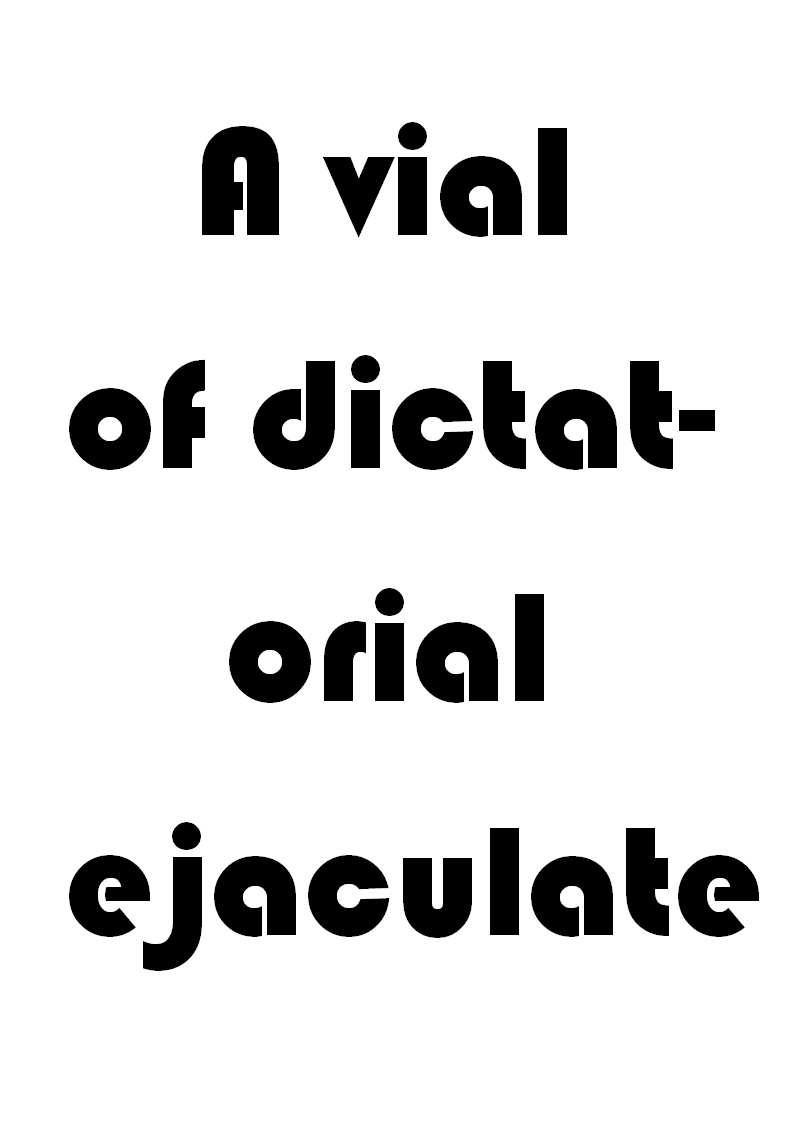
It seems too there may be a multitude of energy fields within this one energy field, and that every city or family or community, every planet has its own field containing all the information from its past (as we would conceive of it), possibly even an infinite number of alternatives to that past. When you go to a city, see if you can’t slow your mind down and get below the surface boil and bustle, the constant flux, to a more subtle undercurrent of energy, which feeds and feeds off of the physical and chemical activity of its inhabitants. Strange things begin to happen when you do this – weird coincidences, synchronicity, purposeful encounters – the whole cityscape takes on a hallucinatory quality. But I’ve written about that elsewhere.

I’ve tried to create a few visual poems based on these rather blank, but still assertive poster poems (or statement poems!), none of which I’m entirely satisfied with, but which I present here because I probably won’t try to improve on them, and now, for the time being at least, in this one particular dimension of space time, the matter is swiftly and quietly drawing to a close.


Friday, 11 May 2012
Vital Source

For anyone interested in contemplative prayer or Christian spirituality, I've published, perhaps rather hastily given my technological incompetence, an ebook called Vital Source: Diary of an Urban Contemplative. It's part prayer journal, part spiritual autobiography. Formatting these things is a bit of a nightmare but I don't think the reading experience will be too diminished by the glitches. At any rate, if it's at all your thing, I hope you enjoy it. It's fairly cheap and Kindle friendly.
Sunday, 6 May 2012
Review of Bobby Parker's "Comberton".
Some questions for you to ponder, or ignore, whichever you prefer:
Why are we born into the circumstances we are born into, given the parents we are given, brought up in one particular time or place as opposed to another? How can we deal with those circumstances, however difficult, in a way that allows us to make sense of them, make sense of ourselves? How can we emerge from these circumstances with a genuine and intact sense of Self, a truth and honesty in our Being which allows us to accept them and transcend them and find, well, a serious slice of inner contentment?
Maybe these questions aren’t important to you. Maybe the mere act of survival is enough. Maybe you just want to get from the cradle to the grave relatively unscathed. Or maybe you just want to escape these pesky circumstances, surround yourself with nice things and respectable people, wealth, learning, in a bid to protect yourself from the crazy filthy mess of the crazy filthy world. Fine. Lovely. But for me, and I’m guessing for someone like Bobby Parker, that just isn’t enough, because to ignore these questions doesn’t chime with a sense of who we actually are. Even in the midst of the crack blown shitstorm, Bobby says:
“I lived to score. It gave my life meaning.”
Simple. To the point. In actual fact, Bobby writes the way I thought I might like to write when I first started writing. I have a few early short stories which wander into Bobby Parker territory, but they don’t quite cut it, probably because the crazy filthy world they explore was only at the edge of my experience until my late teens, when I drifted into it in order to “find something other”, sheltered as I was in a happy homey Christian dream bubble (which I’m entirely grateful for now, btw). For Parker, however, this world has been internalised since day one, crystallised in a sensitive, honest mind, and poured out in some of the cleanest writing out there. Clean?
“GIRLS WHO
DROVE ME
CRAZY
BOYS WHO
SHOWED ME
THEIR COCKS”
This, handwritten on a dirty post it note. It’s the honesty that’s clean, the straight-to-the-point directness. There’s no judgement. This is the world as it is without frill or pretty cover up. It’s like the Hindu tantrics who break all kinds of social and sexual taboos to find liberation. Parker and the characters who populate his prose poems and handwritten miniatures simply live, even embrace, their vice, perversion, habit, addiction, squalor, and by doing so, gain some control over their lives. Like Stabby Jim, who steals and wears soiled undergarments before masturbating into them, or Bobby and his friend who enjoy sparking up matches because:
“Every strike seemed to make sense, the flare and stink of them. Flicking them still lit into rubbish bins to start little fires. Something we could control.”
Control here is a form of liberation, a way of making meaning, sense. At other times the characters offer a poignant memory which gives life meaning:
“It seems that Liam’s crying filled my childhood just as much as much as the sound of church bells or ice cream vans.”
Or, sometimes, refuge from the pain:
“Until Gemma’s cool hands closed over my knuckles. Until her warm mouth touched my runny nose and called me sugar in the dark.”
Occasionally however, this sense of liberation becomes complete, reaching spiritual heights or moments of elevated consciousness, as in the post it note poem, scrawled and scored out before the declaration that:
“GOD IS THAT
FEELING I GET
SOMETIMES”.
I love how the “SOMETIMES” hangs at the end here before a final scrawled out word, this after harrowing prose poems about mental breakdown and an orgy involving his sisters-in-law. Parker isn’t using lyrical breaks in the down n dirty prose to evoke transcendence; it’s the handwritten scrawl, the score-out, the cartoon doodle portraying the shame, fear and humiliation of this existence that do so; emotions which become so heightened, so all consuming, that they themselves lead to moments of altered awareness, ecstasy even.
“For the first time since we moved here, I noticed how loud the fan on the bathroom ceiling was. How much it sounded like a voice.”
Or consider the poem where an intense emotional breakdown leads to the poignancy and heightened sentiment of intimate contact with his daughter:
“I nodded through the fear and held out my cartoon hands for the sunshine.”
Occasionally, the supernatural breaks through the fear and shame altogether, like the poem where Parker’s anxiety about his daughter’s birth is calmed by a ragged stranger with “eyes like snow globes” and a bus driver called Gabriel.
Make no mistake, the humiliation and guilt flattens him “like the consequences of a terrible lie”, he feels “like a clown with a virus”; but it’s precisely this humiliation and guilt, disappointment even, which, when it hits fever pitch, breaks into moments of complete realisation and transcendence:
“We stopped in the middle of our game and took turns blowing cigarette smoke into the sunbeam. Ghosts in the gold light. ‘Fucking beautiful . . .’ I whispered.”
Just like the tantrics.
I’m a big fan of Stanislav Grof’s perinatal theories, where he postulates that the child’s journey from the womb through the birth canal into the world forms a blueprint or frame of reference for our psychological journey through life. Don’t worry, I’m not going to psychoanalyse Bobby, and there’s a lot more to the theory than I can explain here, but I do see the experiences Parker describes as analogous to the traumatic journey to new birth. The book finishes with a dramatic explosion of light as our eyes see who we are or what we can really be:
“WE ARE LIGHTS”.
Before this however we are faced with the emotional appeal:
“TOUCH ME”.
I’m not sure where Bobby is in his journey and whether or not he’s heading out of the darkness towards the light. His writing about it is a way of liberating himself from the pain, which in itself suggests a way into something more precious. Wherever he is, I’m glad to be his companion along the way.
http://www.knivesforksandspoonspress.co.uk/comberton.html
Why are we born into the circumstances we are born into, given the parents we are given, brought up in one particular time or place as opposed to another? How can we deal with those circumstances, however difficult, in a way that allows us to make sense of them, make sense of ourselves? How can we emerge from these circumstances with a genuine and intact sense of Self, a truth and honesty in our Being which allows us to accept them and transcend them and find, well, a serious slice of inner contentment?
Maybe these questions aren’t important to you. Maybe the mere act of survival is enough. Maybe you just want to get from the cradle to the grave relatively unscathed. Or maybe you just want to escape these pesky circumstances, surround yourself with nice things and respectable people, wealth, learning, in a bid to protect yourself from the crazy filthy mess of the crazy filthy world. Fine. Lovely. But for me, and I’m guessing for someone like Bobby Parker, that just isn’t enough, because to ignore these questions doesn’t chime with a sense of who we actually are. Even in the midst of the crack blown shitstorm, Bobby says:
“I lived to score. It gave my life meaning.”
Simple. To the point. In actual fact, Bobby writes the way I thought I might like to write when I first started writing. I have a few early short stories which wander into Bobby Parker territory, but they don’t quite cut it, probably because the crazy filthy world they explore was only at the edge of my experience until my late teens, when I drifted into it in order to “find something other”, sheltered as I was in a happy homey Christian dream bubble (which I’m entirely grateful for now, btw). For Parker, however, this world has been internalised since day one, crystallised in a sensitive, honest mind, and poured out in some of the cleanest writing out there. Clean?
“GIRLS WHO
DROVE ME
CRAZY
BOYS WHO
SHOWED ME
THEIR COCKS”
This, handwritten on a dirty post it note. It’s the honesty that’s clean, the straight-to-the-point directness. There’s no judgement. This is the world as it is without frill or pretty cover up. It’s like the Hindu tantrics who break all kinds of social and sexual taboos to find liberation. Parker and the characters who populate his prose poems and handwritten miniatures simply live, even embrace, their vice, perversion, habit, addiction, squalor, and by doing so, gain some control over their lives. Like Stabby Jim, who steals and wears soiled undergarments before masturbating into them, or Bobby and his friend who enjoy sparking up matches because:
“Every strike seemed to make sense, the flare and stink of them. Flicking them still lit into rubbish bins to start little fires. Something we could control.”
Control here is a form of liberation, a way of making meaning, sense. At other times the characters offer a poignant memory which gives life meaning:
“It seems that Liam’s crying filled my childhood just as much as much as the sound of church bells or ice cream vans.”
Or, sometimes, refuge from the pain:
“Until Gemma’s cool hands closed over my knuckles. Until her warm mouth touched my runny nose and called me sugar in the dark.”
Occasionally however, this sense of liberation becomes complete, reaching spiritual heights or moments of elevated consciousness, as in the post it note poem, scrawled and scored out before the declaration that:
“GOD IS THAT
FEELING I GET
SOMETIMES”.
I love how the “SOMETIMES” hangs at the end here before a final scrawled out word, this after harrowing prose poems about mental breakdown and an orgy involving his sisters-in-law. Parker isn’t using lyrical breaks in the down n dirty prose to evoke transcendence; it’s the handwritten scrawl, the score-out, the cartoon doodle portraying the shame, fear and humiliation of this existence that do so; emotions which become so heightened, so all consuming, that they themselves lead to moments of altered awareness, ecstasy even.
“For the first time since we moved here, I noticed how loud the fan on the bathroom ceiling was. How much it sounded like a voice.”
Or consider the poem where an intense emotional breakdown leads to the poignancy and heightened sentiment of intimate contact with his daughter:
“I nodded through the fear and held out my cartoon hands for the sunshine.”
Occasionally, the supernatural breaks through the fear and shame altogether, like the poem where Parker’s anxiety about his daughter’s birth is calmed by a ragged stranger with “eyes like snow globes” and a bus driver called Gabriel.
Make no mistake, the humiliation and guilt flattens him “like the consequences of a terrible lie”, he feels “like a clown with a virus”; but it’s precisely this humiliation and guilt, disappointment even, which, when it hits fever pitch, breaks into moments of complete realisation and transcendence:
“We stopped in the middle of our game and took turns blowing cigarette smoke into the sunbeam. Ghosts in the gold light. ‘Fucking beautiful . . .’ I whispered.”
Just like the tantrics.
I’m a big fan of Stanislav Grof’s perinatal theories, where he postulates that the child’s journey from the womb through the birth canal into the world forms a blueprint or frame of reference for our psychological journey through life. Don’t worry, I’m not going to psychoanalyse Bobby, and there’s a lot more to the theory than I can explain here, but I do see the experiences Parker describes as analogous to the traumatic journey to new birth. The book finishes with a dramatic explosion of light as our eyes see who we are or what we can really be:
“WE ARE LIGHTS”.
Before this however we are faced with the emotional appeal:
“TOUCH ME”.
I’m not sure where Bobby is in his journey and whether or not he’s heading out of the darkness towards the light. His writing about it is a way of liberating himself from the pain, which in itself suggests a way into something more precious. Wherever he is, I’m glad to be his companion along the way.
http://www.knivesforksandspoonspress.co.uk/comberton.html
Tuesday, 1 May 2012

Saturday, 28 April 2012

Thursday, 26 April 2012
The Poet as Shaman

Marks on wood work like magic symbols, signs of an essential communion with the natural world. This week I was among the trees and all the living things that continue to exist despite my lack of care for them. I came across some marks on trees and felt myself join with the energy these marks created. I began to think of the changes they made in me and how these changes might relate to the mark-maker/poet as unwitting
shaman.

When my friend Geof Huth performed a poemsong at the Text Festival in Bury exactly a year ago this weekend, I thought he was a shaman. He sang into the collective energy of the room and, somehow, altered it. How this works at an atomic or subatomic level is beyond me, but I do know how it affected my body, and, more than that, how his song reached beyond my body’s physicality to a more subtle level of being where I might have found myself interacting with the memories of the room and everyone in it. His song transformed the room, altered the mind of each individual, and by extension, the families and communities those individuals belonged to.
This adjustment, this ability to heal and transform makes every poet potentially a shaman, particularly I think sound and visual poets, whose work frequently steps outside meaning into areas of pure sign, pure sound. What matters most is the loving intention he or she brings to their marks and utterances, and how that communicated intention can alter the reader/hearer’s state of being.

All of which makes nonsense of poetry wars and poetic rivalries. When a poet sings, he sings for all the poets, for a whole community of poets; similarly, when one of us suffers, we all suffer, whether we’re aware of it or not.
The principle reaches into every community beyond the poetry world and is precisely why these communities need poets - as shaman, as healers, even if the community at large remains totally oblivious to their role as such. Words work their magic below the surface, they resonate in a secret space where everything is interconnected. The poet has access to this secret space.
So when we sing or write we should think on the transformations we affect at the very core of being, where body and mind are indistinguishable, and how sound and symbol can re-pattern unconscious mind. Think on how an individual exists within a group or community, and how that community exists within an individual, and how the poet is the unacknowledged healer in that dynamic. Then enter the world of poet as shaman, and see what happens.

Wednesday, 25 April 2012

Chatelherault Song
Chatelherault Song (Click on to visit SoundCloud).

The song was recorded at the Ancient Oaks in Chatelerhaut near Hamilton, Scotland. Takes a wee minute to get going and is jolly enough. Some boys passed at one point but I pressed on. I wanted sound to express the kinship with the trees. I don't think I succeeded (sometimes I lose the edge of a song I've started as soon as I switch on a recorder), but the walk and the photographs I took around the Ancient Oaks gave me a lift and a few ideas for blog posts, visual poems etc. So more to come hopefully.
On the way up I was followed by some tiny birds. Really rather remarkable! At one point I had a robin, two blue tits and two finches (I think) flying around me, a metre or so from my face. I held out my hand. One of the finches fluttered up and hovered mid air just inches from my fingers, before backing up, rather comically, realising I had no food. A totally magical experience! I felt like a faux St Francis. I am a faux St Francis.
It's a place I'll return to because it inspires me, and gets me out of town into somewhere more peaceable. I may even become a nature poet. I may not. I would like to sing more songs with the birds up there however, perhaps even become as disinhibited as they are.

The song was recorded at the Ancient Oaks in Chatelerhaut near Hamilton, Scotland. Takes a wee minute to get going and is jolly enough. Some boys passed at one point but I pressed on. I wanted sound to express the kinship with the trees. I don't think I succeeded (sometimes I lose the edge of a song I've started as soon as I switch on a recorder), but the walk and the photographs I took around the Ancient Oaks gave me a lift and a few ideas for blog posts, visual poems etc. So more to come hopefully.
On the way up I was followed by some tiny birds. Really rather remarkable! At one point I had a robin, two blue tits and two finches (I think) flying around me, a metre or so from my face. I held out my hand. One of the finches fluttered up and hovered mid air just inches from my fingers, before backing up, rather comically, realising I had no food. A totally magical experience! I felt like a faux St Francis. I am a faux St Francis.
It's a place I'll return to because it inspires me, and gets me out of town into somewhere more peaceable. I may even become a nature poet. I may not. I would like to sing more songs with the birds up there however, perhaps even become as disinhibited as they are.
Wednesday, 4 April 2012
Look! A New Blog!
I've started a new blog consisting solely of three word minimalist poems. It's called trinitreat and I hope you'll pop in and have a look. I'm going to try to publish at least one poem a day - time, place, health permitting - until I run out of steam, but there may be more, like the six I posted today to start things off. Hope you enjoy them and hallelujah!
Sunday, 1 April 2012
InterNaPwoWriMo V
Well, it's here again. Hooray! Jog on over to http://scowords.blogspot.co.uk/ for this years festival of pwoermds. There are words and more words and all sorts of surprises. There are also links to other pwoermdists' blogs, but I'm guessing Geof Huth has linked or will link to all this year's participants, so nip into Geof's http://napwowrimo.blogspot.co.uk/ for a full list.
Happiness is a month of pwoermding. Yeah!
Happiness is a month of pwoermding. Yeah!
Wednesday, 21 March 2012
Monday, 12 March 2012

Funeral Glyph
 An improvised window poem written on the front door of the church at my grandpa's recent funeral. Not very clear or original but you may see a sickle and you may see a vision of the afterlife. Or you may just see a wet, miserable day brightened by the memory of a fine, old gent who was a very fine, old grandfather to me. The poem reads:
death/reap
Moments later the poem started to drip away, much like life, but I didn't manage to take a photo of that because I didn't want to draw too much attention to myself, the church elders being a rather solemn lot. No matter. Peace to them and peace to my grandpa. And peace to you.
Friday, 9 March 2012
Mad Hatter's Review Blog
Some prose poems of mine. Or are they short short stories? Not sure really. Have a look and see what you think . . .
http://madhattersreview.com/blog/archives/1089
http://madhattersreview.com/blog/archives/1089
Monday, 5 March 2012
Panda
 The first wound is the birth wound, separation from the mother. Like Moses, we are cradled in a basket, comforted. No doubt further wounds are inflicted as we grow and we carry them into the world as thoughts, feelings, attitudes, actions.
Imagine someone bearing the wounds of the whole world, not just in his body, but in his heart. Imagine the folly in believing this. What if we did believe however, and in believing, our wounds were healed and we were open to the life that falls from the sky, rises from the earth.
Imagine a tiny spot of blood . . .

Sunday, 4 March 2012
Shadowtrain
Sometimes I'll read a poet and be inspired to write something in response, with a little feel or style borrowed from the poet. Here are three sonnets I wrote after reading Emily Critchley - no where near as good as her wonderful sequence of course, but genuine enough I hope:
http://www.shadowtrain.com/id441.html
In fact, best just forget these and go read Emily. . .
http://www.shadowtrain.com/id441.html
In fact, best just forget these and go read Emily. . .
Subscribe to:
Posts (Atom)